
Why Every Business Needs an AI Agent Strategy in 2026
Artificial Intelligence has moved far beyond answering questions in a chatbot window. In 2026, businesses are increasingly adopting AI agents—software systems that can understand goals, make decisions, complete multi-step tasks, and work alongside employees. Whether you're running a startup, an e-commerce store, or a large enterprise, having an AI agent strategy is no longer a futuristic idea. It is becoming a competitive advantage. This article explains what AI agents are, why they matter, and how businesses can build a successful AI agent strategy.
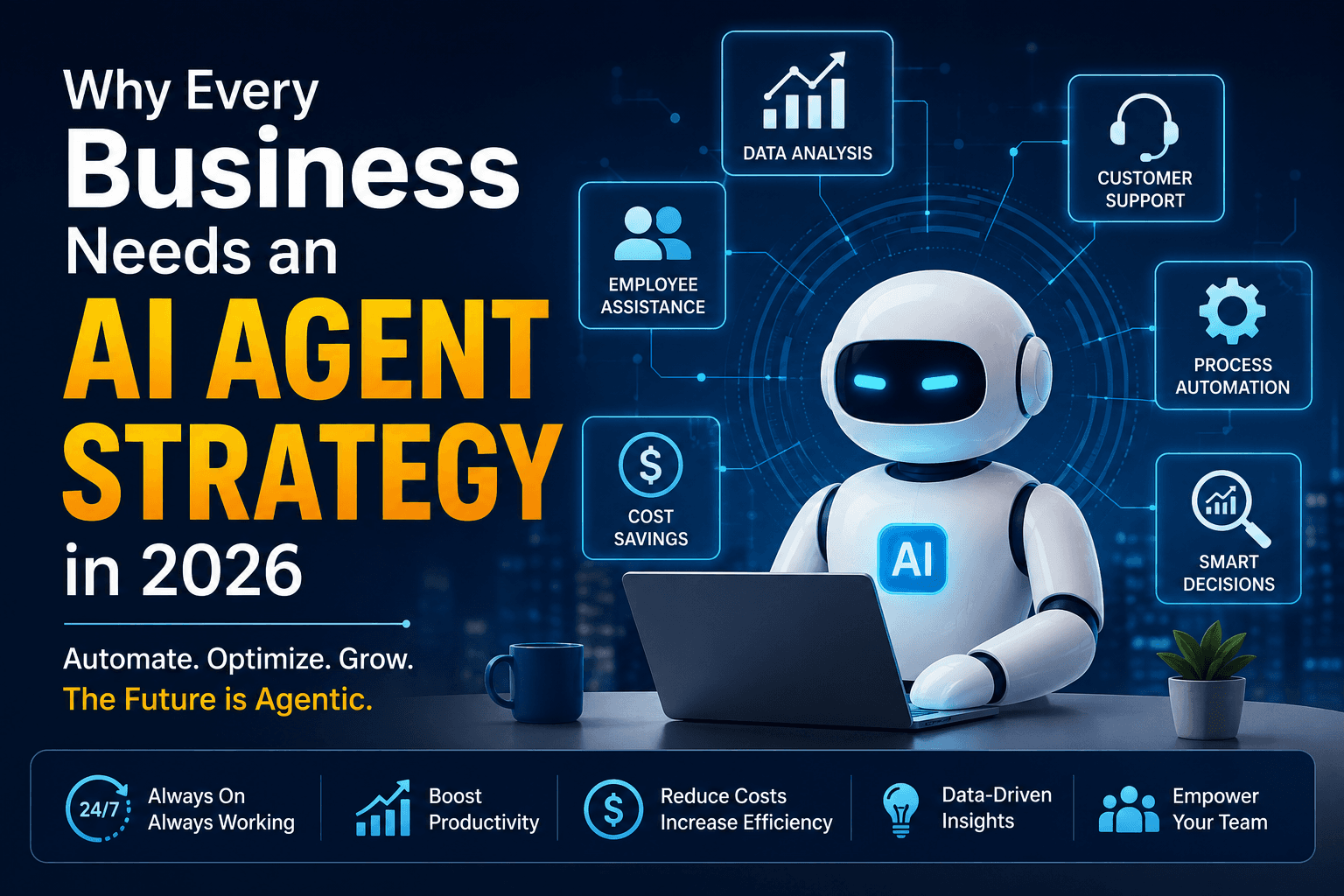
Why AI Agents Are Growing So Fast
Several factors are driving the rapid adoption of AI agents in 2026.
Better AI Models
Modern AI models understand language, images, documents, and structured data with impressive accuracy, making them suitable for real business tasks.
Lower Operating Costs
Cloud-based AI services have become more affordable, allowing businesses of all sizes to deploy AI without massive upfront investments.
Demand for Faster Decisions
Companies need to analyze data, respond to customers, and complete routine tasks much faster than before. AI agents help reduce delays and improve operational efficiency.
Benefits of an AI Agent Strategy
1. Increased Productivity
Employees spend less time on repetitive work like:
Email responses
Report generation
Data entry
Meeting summaries
Document analysis
This allows teams to focus on higher-value activities such as strategy, innovation, and customer relationships.
2. Better Customer Support
AI agents can:
Answer customer questions 24/7
Resolve common issues
Track orders
Schedule appointments
Escalate complex cases to human agents
Customers receive faster responses, while support teams can focus on more challenging requests.
3. Smarter Business Decisions
AI agents can continuously monitor dashboards, identify unusual trends, and generate insights from large volumes of data.
Instead of manually reviewing reports, managers receive proactive recommendations that help them act quickly.
4. Cost Savings
Businesses can reduce expenses by automating repetitive processes, minimizing manual errors, and improving operational efficiency. Over time, these savings can significantly improve profitability.
5. Better Employee Experience
AI agents can assist employees by:
Searching internal knowledge bases
Drafting reports
Summarizing meetings
Automating repetitive administrative tasks
This reduces workload and helps teams work more efficiently.
Real-World Business Use Cases
Sales
AI agents can:
Qualify leads
Send follow-up emails
Update CRM systems
Prepare sales reports
Marketing
Marketing teams use AI agents for:
Content generation
Campaign analysis
Keyword research
Social media scheduling
Competitor monitoring
Finance
Finance departments use AI agents to:
Process invoices
Detect unusual transactions
Generate financial reports
Forecast revenue
Human Resources
HR teams use AI agents to:
Screen resumes
Schedule interviews
Answer employee questions
Assist with onboarding
Operations
Operations teams benefit from AI agents that:
Monitor inventory
Track supply chains
Predict equipment maintenance
Optimize workflows
How to Build an AI Agent Strategy
Step 1: Identify Repetitive Tasks
List tasks that consume significant employee time and involve predictable workflows.
Step 2: Prioritize High-Impact Areas
Focus on processes where automation can quickly improve efficiency or customer experience.
Step 3: Select the Right AI Tools
Evaluate AI platforms based on integration capabilities, security, scalability, and ease of use.
Step 4: Keep Humans in the Loop
AI should support—not replace—human judgment, especially for decisions involving ethics, legal compliance, or customer relationships.
Step 5: Measure Results
Track key performance indicators (KPIs) such as:
Time saved
Cost reduction
Customer satisfaction
Employee productivity
Accuracy improvements
Use these metrics to refine your AI strategy over time.
Common Challenges
While AI agents offer significant benefits, businesses should also address:
Data privacy and security
Integration with existing systems
Employee training
Governance and compliance
Ongoing monitoring and maintenance
A successful AI strategy balances innovation with responsible oversight.
The Future of AI Agents
AI agents are expected to become increasingly capable of handling complex workflows, collaborating across departments, and providing real-time insights. Rather than replacing entire workforces, they are likely to augment human capabilities, allowing employees to focus on creativity, problem-solving, and strategic decision-making.
Organizations that begin experimenting with AI agents today will be better positioned to adapt as the technology continues to mature.
Final Thoughts
In 2026, AI agents are no longer experimental tools—they are becoming a practical part of modern business operations. From improving customer service to streamlining internal processes and supporting data-driven decisions, AI agents can deliver measurable value across industries.
The key is not to automate everything at once. Start with a few high-impact use cases, measure results, and expand thoughtfully. Businesses that develop a clear AI agent strategy today will be better prepared to compete, innovate, and grow in the years ahead.
Key Benefits of Artificial Workflow Automation
Increased Productivity
Boost operational efficiency.
Cost Savings
Boost operational efficiency.
Improved Accuracy
Boost operational efficiency.
Scalability
Boost operational efficiency.
Better Decisions
Boost operational efficiency.