
Agentic AI & Multi-Agent Systems: How Autonomous AI Is Transforming Business Workflows in 2026
Discover how Agentic AI and Multi-Agent Systems are moving beyond traditional chatbots to automate complete business workflows. Learn their benefits, use cases, and why they are shaping the future of AI in 2026.
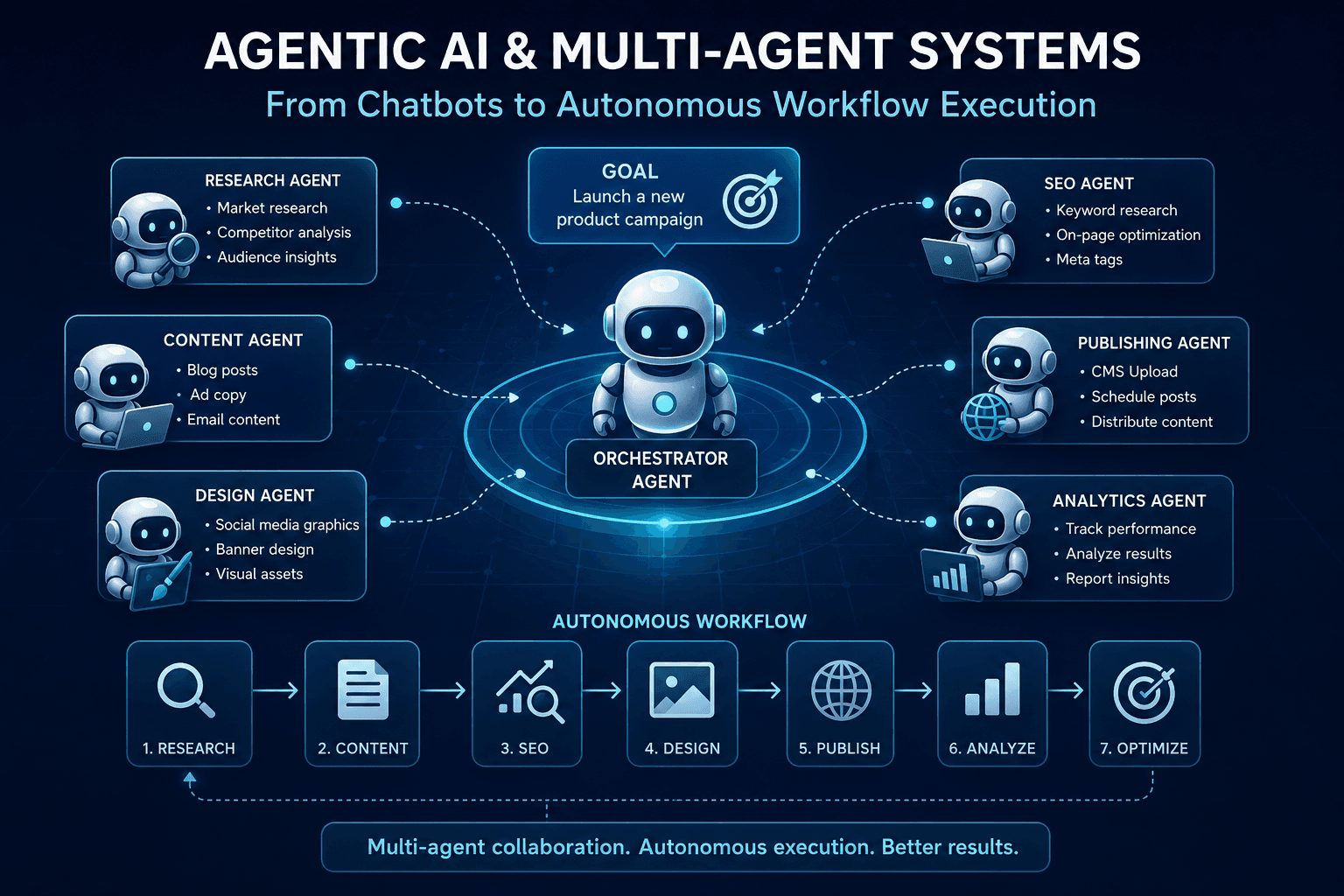
Agentic AI & Multi-Agent Systems: How AI Is Moving Beyond Chatbots in 2026
Artificial Intelligence has come a long way in just a few years. Not long ago, most businesses were excited about AI chatbots that could answer customer questions, write emails, or help with basic tasks. These tools were useful, but they still depended on people to guide every step.
Today, AI is evolving into something much more powerful.
Instead of simply answering questions, modern AI systems can plan tasks, make decisions, use different software tools, and complete entire workflows with very little human involvement. This new generation of AI is known as Agentic AI, and it's changing the way businesses operate.
What Is Agentic AI?
Think of Agentic AI as a digital employee rather than a digital assistant.
A chatbot waits for you to ask a question before responding. An AI agent, on the other hand, works toward achieving a goal. Once you tell it what you want to accomplish, it figures out the steps needed to get there.
For example, imagine you're launching a new product.
With a traditional chatbot, you would ask it to write a social media post, then another prompt for an email, another for a blog, and another for SEO suggestions.
An AI agent can handle all of those tasks on its own. It can research the market, understand your audience, write marketing content, generate social media captions, prepare emails, and even suggest improvements based on the results.
Instead of completing one task at a time, it completes the entire workflow.
What Are Multi-Agent Systems?
As businesses grow, one AI agent isn't always enough.
That's where Multi-Agent Systems come in.
Rather than relying on a single AI to do everything, multiple specialized AI agents work together as a team. Each one focuses on a specific responsibility, just like people in a company.
For example, a content marketing team powered by AI might include:
A Research Agent that finds trending topics and keywords.
A Content Agent that writes the article.
An SEO Agent that optimizes the content for search engines.
A Design Agent that creates banners and graphics.
A Publishing Agent that uploads the content to the website.
An Analytics Agent that tracks performance after publishing.
Each agent does its own job while sharing information with the others. The result is a faster, more organized workflow that requires much less manual effort.
Why Businesses Are Interested
The biggest advantage of Agentic AI is that it saves time.
Instead of spending hours switching between different tools and repeating similar tasks, businesses can define an objective and allow AI to handle much of the work.
This helps teams:
Finish projects more quickly.
Reduce repetitive work.
Improve productivity.
Make better use of employee time.
Deliver faster customer service.
Focus on creative and strategic work.
Rather than replacing people, Agentic AI helps employees spend less time on routine tasks and more time solving important business problems.
Real-World Examples
Customer Support
Modern AI agents can answer customer questions, verify account details, process refund requests, update CRM systems, and hand complex cases over to human support teams when necessary.
Customers receive faster responses while support teams can focus on situations that truly need personal attention.
Marketing
Marketing teams are already using AI to research topics, write blogs, create social media content, generate email campaigns, and monitor campaign performance.
Instead of managing each task separately, AI can coordinate the entire marketing process from start to finish.
Software Development
Developers are also benefiting from Agentic AI.
AI agents can write code, review pull requests, find bugs, generate documentation, create automated tests, and even assist with deployments.
This doesn't replace developers, but it helps them work faster and spend more time solving complex technical challenges.
Healthcare
Hospitals and healthcare providers are using AI to schedule appointments, organize patient records, assist with documentation, and simplify administrative work.
Doctors and nurses can then dedicate more of their time to patient care.
Finance
Banks and financial organizations are using AI agents to detect fraud, analyze financial data, monitor compliance, generate reports, and identify potential risks more efficiently than traditional software.
Things Businesses Should Consider
Although Agentic AI offers many advantages, it also brings new responsibilities.
Businesses need to ensure that AI systems are secure, protect customer data, and follow industry regulations. Human oversight is still essential, especially when important business decisions are involved.
AI should support people, not replace accountability.
What Does the Future Look Like?
We're moving toward a future where AI won't just answer questions—it will actively work alongside people.
Instead of using one chatbot for everything, businesses will build teams of AI agents that collaborate, communicate, and complete complex projects together.
As these technologies continue to improve, we'll see AI handling more routine work while people focus on creativity, innovation, and decision-making.
Final Thoughts
The shift from chatbots to Agentic AI is one of the biggest changes happening in technology today.
Businesses are no longer looking for AI that simply provides answers. They want AI that can plan, collaborate, and complete meaningful work from start to finish.
Whether it's creating marketing campaigns, developing software, managing customer support, or automating everyday business operations, Agentic AI and Multi-Agent Systems are helping organizations work smarter and faster.
Companies that start exploring these technologies today will be in a stronger position to compete as AI becomes a normal part of everyday business.
Key Benefits of Artificial Workflow Automation
Increased Productivity
Boost operational efficiency.
Cost Savings
Boost operational efficiency.
Improved Accuracy
Boost operational efficiency.
Scalability
Boost operational efficiency.
Better Decisions
Boost operational efficiency.