
Next.js 16 vs React: Which Is Better for Modern Web Development in 2026?
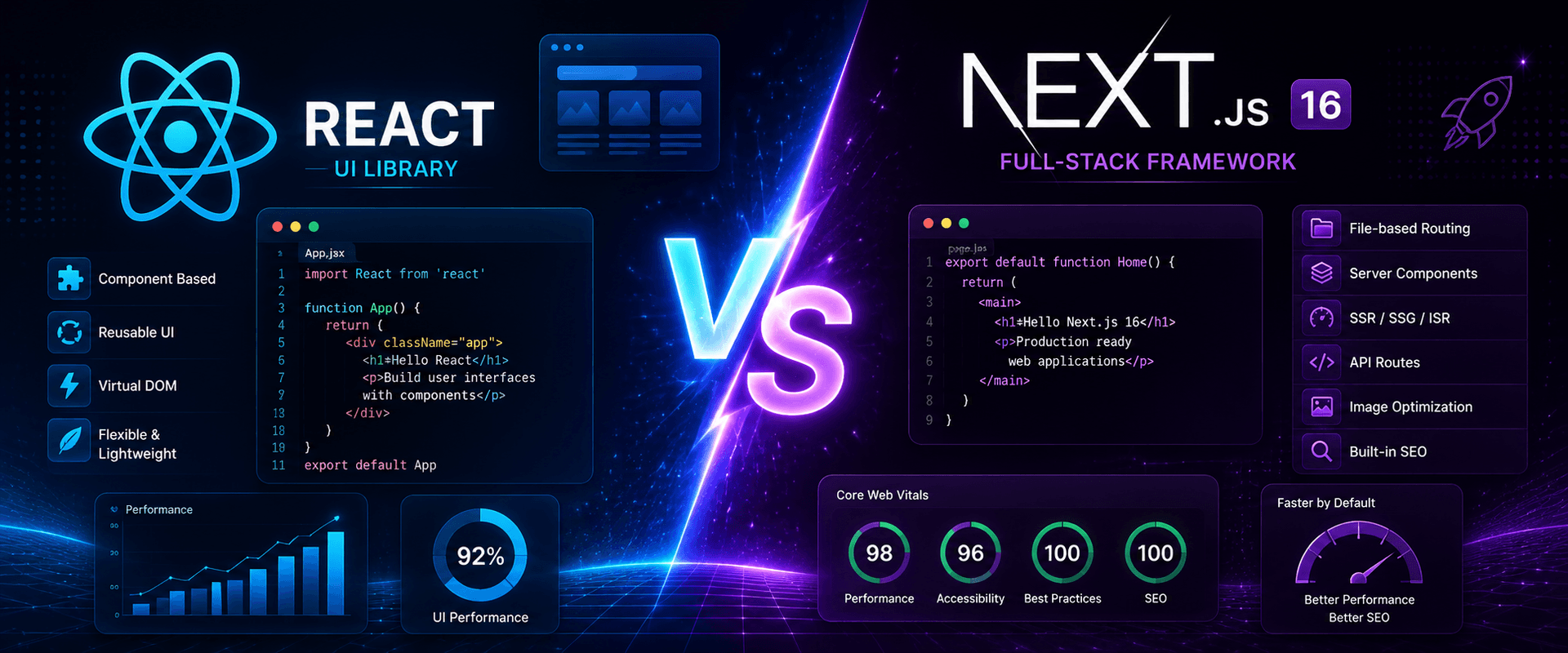
React and Next.js are two of the most popular technologies for modern web development. While React offers flexibility for building dynamic user interfaces, Next.js provides powerful features like server-side rendering, routing, and SEO optimization. In this guide, we'll compare both technologies to help you choose the right framework for your next project.
Introduction
Choosing the right framework is one of the most important decisions when starting a web development project. React and Next.js are closely related, but they solve different problems.
React is a JavaScript library for building user interfaces, while Next.js is a full-stack framework built on top of React. If your project requires better SEO, faster performance, and production-ready features, Next.js is often the preferred choice. If you need complete flexibility for building interactive applications, React remains an excellent option.
What is React?
React is an open-source JavaScript library developed by Meta. It helps developers create fast, interactive, and reusable user interface components.
Best For
• Single Page Applications (SPAs)
• Admin Dashboards
• Internal Business Tools
• Interactive User Interfaces
Advantages
• Easy to learn
• Reusable components
• Large community
• Flexible architecture
What is Next.js 16?
Next.js is a React framework developed by Vercel. It includes built-in routing, server-side rendering, API routes, image optimization, and SEO features, making it ideal for production-ready websites.
Best For
• Business Websites
• E-commerce Platforms
• SaaS Applications
• Blogs
• Marketing Websites
Advantages
• Built-in SEO
• Faster Performance
• Better Page Speed
• File-based Routing
• Server Components
React vs Next.js Comparison
Feature | React | Next.js 16 |
Type | UI Library | Full-Stack Framework |
SEO | Manual | Built-in |
Routing | React Router | Built-in |
Rendering | Client Side | SSR, SSG, ISR & CSR |
Performance | Good | Excellent |
Learning Curve | Easy | Moderate |
Which One Should You Choose?
Choose React if:
• You're building an internal dashboard.
• You need maximum flexibility.
• SEO is not your highest priority.
Choose Next.js 16 if:
• You need better Google rankings.
• You're building a business website or SaaS platform.
• Performance and SEO matter.
• You want production-ready features out of the box.
Conclusion
Both React and Next.js are powerful technologies, but the right choice depends on your project requirements.
React is perfect for building highly interactive user interfaces, while Next.js offers additional features that improve SEO, performance, and scalability. For most modern business websites and production applications in 2026, Next.js 16 provides a more complete development experience.
If your goal is to build a fast, scalable, and SEO-friendly application, Next.js is an excellent choice. If flexibility and custom UI development are your priorities, React continues to be one of the best JavaScript libraries available.
Key Benefits of Web Workflow Automation
Increased Productivity
Boost operational efficiency.
Cost Savings
Boost operational efficiency.
Improved Accuracy
Boost operational efficiency.
Scalability
Boost operational efficiency.
Better Decisions
Boost operational efficiency.