
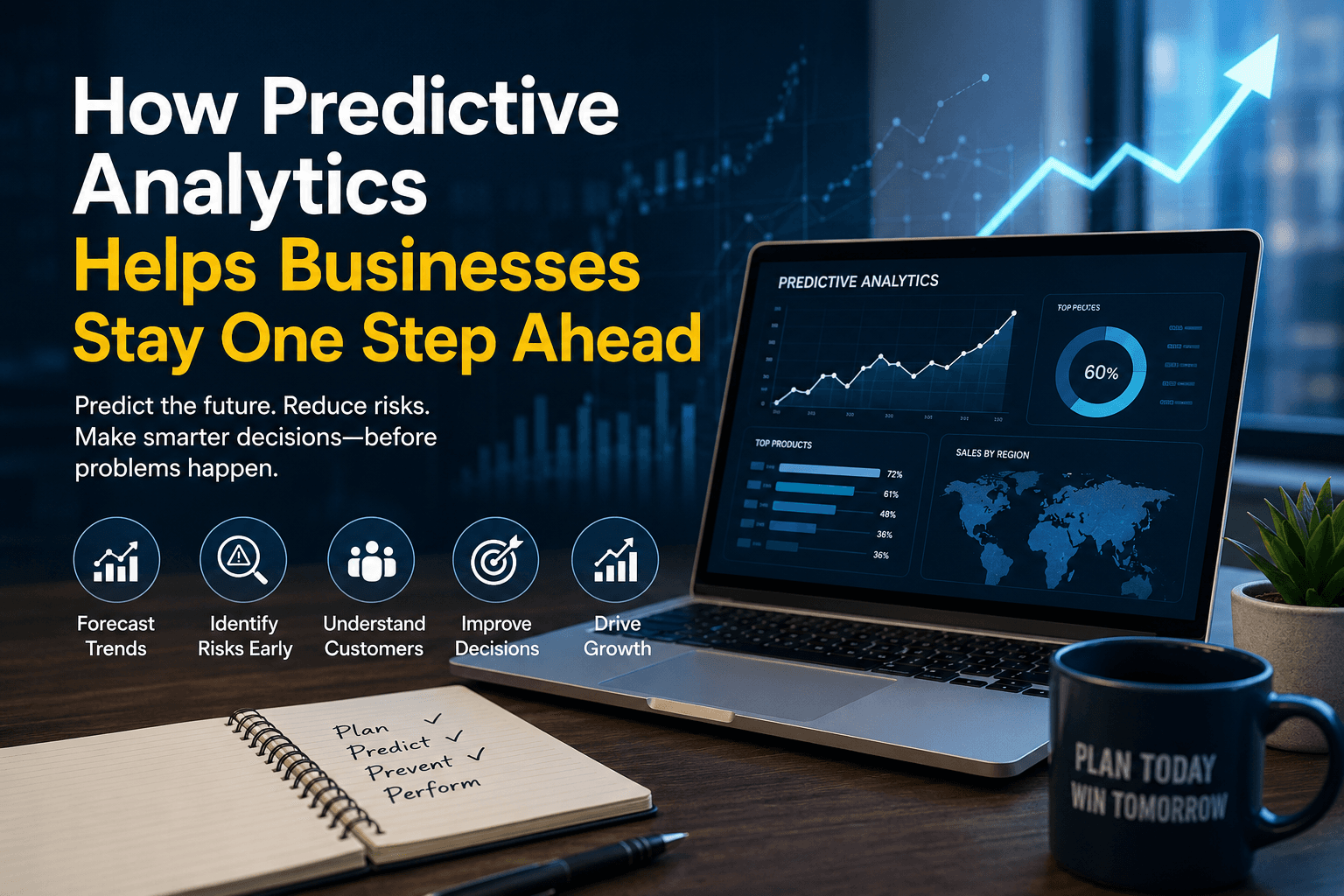
How Predictive Analytics Helps Businesses Stay One Step Ahead
In business, timing matters a lot. Sometimes the biggest challenge is not solving a problem — it is seeing it early enough to do something about it. That is exactly where predictive analytics is making a huge difference. Instead of only looking at what already happened, predictive analytics helps businesses understand what is likely to happen next. It uses past data, patterns, and trends to forecast outcomes, spot risks, and support better decisions. In 2026, this is becoming one of the most valuable tools for companies that want to move faster, reduce uncertainty, and plan with more confidence.
What Predictive Analytics Actually Means
Predictive analytics is a way of using historical data, machine learning, and statistical models to predict future outcomes. In simple words, it helps businesses answer questions like:
Which customers are likely to stop buying?
What products will be in higher demand next month?
When is sales performance likely to drop?
Which leads are more likely to convert?
Where can operational problems happen before they become serious?
This shifts business decision-making from reactive to proactive. Instead of waiting for a drop in revenue, customer complaints, or stock issues, teams can identify warning signs earlier and act before the problem grows.
Why Businesses Are Paying More Attention to It
The business environment has become much faster and more unpredictable. Customer behavior changes quickly, market conditions shift, and competition is stronger than ever. In that kind of environment, relying only on monthly reports or past performance is no longer enough.
Predictive analytics gives companies a forward-looking view. It helps them prepare for what might happen rather than simply reviewing what already went wrong. That is why it is becoming important across industries like retail, healthcare, finance, logistics, e-commerce, and even HR.
How Predictive Analytics Helps Businesses Stay Ahead
1. It helps forecast customer behavior
One of the biggest advantages of predictive analytics is understanding customers better. Businesses can use it to identify buying patterns, predict churn, recommend products, and create more personalized experiences.
For example, if a company sees that certain customers are becoming less active, predictive models can flag them before they leave completely. The business can then step in with a targeted offer, support, or campaign to retain them.
This kind of early action can improve customer retention and reduce revenue loss.
2. It improves demand forecasting
Many businesses struggle with either too much inventory or too little. Both create problems. Overstocking ties up money, while understocking leads to missed sales and unhappy customers.
Predictive analytics helps businesses estimate future demand based on past sales, seasonality, customer trends, promotions, and external factors. This allows teams to make smarter inventory and supply chain decisions.
Instead of reacting after products run out or warehouses fill up, businesses can plan stock levels more accurately in advance.
3. It supports better financial planning
Finance teams use predictive analytics to forecast revenue, expenses, cash flow, and risks. This makes budgeting and planning much more realistic.
Rather than making assumptions based only on last year’s numbers, businesses can model different future scenarios and prepare for them. This is especially useful in uncertain markets where small changes can affect profits quickly.
It also helps leadership teams make strategic decisions with more confidence because they are not relying only on guesswork.
4. It identifies risks before they become costly
Every business faces risks — customer churn, fraud, supply chain issues, delayed payments, or operational bottlenecks. The challenge is spotting them before they become expensive problems.
Predictive analytics can detect patterns that indicate risk. For example:
unusual transaction behavior may signal fraud
delayed engagement may suggest a customer is about to leave
repeated delivery delays may point to a supply chain issue
changing sales patterns may indicate a future revenue slowdown
This early visibility gives businesses time to respond before the issue affects performance.
5. It makes sales and marketing more effective
Not every lead is equally valuable, and not every campaign performs the same way. Predictive analytics helps sales and marketing teams focus on the right audience at the right time.
It can help answer questions like:
Which leads are most likely to convert?
Which customers are ready for an upsell?
What type of campaign is likely to perform best?
Which customer segment is at risk of becoming inactive?
This improves campaign targeting, reduces wasted effort, and increases return on marketing spend.
Predictive Analytics Is Not Just for Large Companies Anymore
Earlier, predictive analytics was mostly associated with large enterprises that had massive data teams and expensive systems. That is changing quickly.
Today, even mid-sized businesses and growing startups can use predictive analytics through modern BI tools, cloud platforms, and AI-powered analytics solutions. Many platforms now include forecasting features, smart insights, and easy integrations that make advanced analytics more accessible.
That means businesses do not always need a huge technical setup to start benefiting from predictive thinking.
The Real Advantage: Better Decisions Before Problems Happen
The biggest value of predictive analytics is not just prediction itself — it is preparation. When businesses know what is likely to happen, they can respond earlier, plan better, and make decisions with more clarity.
Instead of asking, “What went wrong?” after the damage is done, they can start asking, “What should we do now to avoid that outcome?”
That shift changes how businesses operate. It reduces surprises, improves planning, and creates a stronger competitive advantage.
Final Thoughts
In 2026, businesses cannot afford to rely only on hindsight. Markets move too fast, customer expectations are too high, and the cost of delayed decisions is growing. Predictive analytics gives companies a way to look forward, not just backward.
It helps them anticipate customer needs, plan inventory, manage risks, improve sales strategies, and make smarter decisions before problems appear. Businesses that use predictive analytics well are not just reacting faster — they are planning smarter from the beginning.
And in a world where timing often decides success, staying one step ahead can make all the difference.
Key Benefits of Data Workflow Automation
Increased Productivity
Boost operational efficiency.
Cost Savings
Boost operational efficiency.
Improved Accuracy
Boost operational efficiency.
Scalability
Boost operational efficiency.
Better Decisions
Boost operational efficiency.