
Google's AI Spending Surge: Why Big Tech Is Investing Billions in AI Infrastructure
Artificial Intelligence has entered a new phase. The competition is no longer just about creating smarter AI models—it's about building the infrastructure that powers them. Google's parent company, Alphabet, recently increased its planned capital spending for 2026 to approximately $195–205 billion, with a significant portion dedicated to expanding AI infrastructure. The company says demand for AI services continues to exceed available computing capacity, prompting additional investment in data centers, servers, networking, and custom AI chips. This isn't an isolated move. Microsoft, Amazon, Meta, and other technology giants are also investing heavily in AI infrastructure, marking one of the largest technology investment cycles in history. Analysts estimate that the largest U.S. tech companies could collectively spend well over $700 billion on AI-related capital expenditures in 2026.
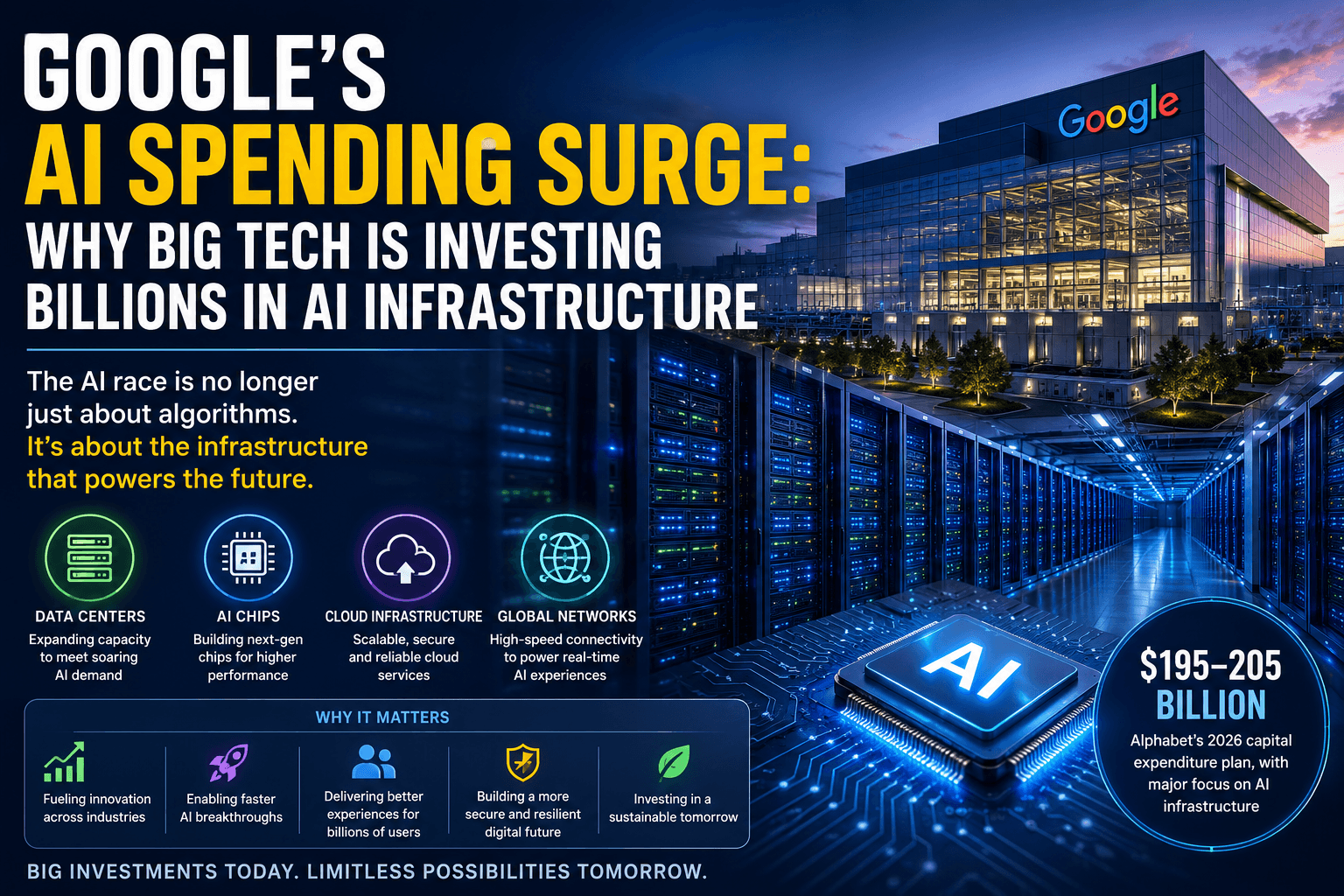
The New AI Race Is About Infrastructure
When ChatGPT launched in late 2022, many people believed the AI race would be won by whoever built the best chatbot.
In 2026, that assumption has changed.
Today's competition revolves around who can provide the fastest, most reliable, and most scalable AI services. Achieving that requires enormous investments in physical infrastructure, including:
AI-optimized data centers
High-performance GPUs
Custom AI chips
Global fiber-optic networks
Cloud computing platforms
Advanced cooling and power systems
Without this infrastructure, even the most advanced AI models cannot serve millions—or billions—of users efficiently.
Why Google Is Spending More Than Ever
Alphabet recently reported record growth in its cloud business, driven largely by enterprise demand for AI services. Google Cloud revenue increased sharply, and the company stated that customer demand for AI infrastructure and AI solutions continues to outpace available capacity.
The increased investment will help Google:
Expand AI data centers
Build more computing capacity
Develop next-generation Tensor Processing Units (TPUs)
Improve Google Cloud AI services
Support Gemini AI models
Deliver faster AI experiences across Search, Workspace, and other products
According to Alphabet executives, expanding infrastructure is essential to meeting the growing needs of enterprise customers and developers.
Why Infrastructure Matters More Than AI Models
Most people interact with AI through applications such as chatbots or productivity tools.
Behind every AI response, however, is a vast network of servers performing billions of calculations in real time.
Every AI-generated answer requires:
Processing power
High-speed networking
Massive memory
Reliable storage
Continuous electricity
Sophisticated cooling systems
As AI usage grows, so does the need for larger and more efficient infrastructure.
This is why today's AI race increasingly resembles the early days of the internet, when companies invested heavily in broadband networks, fiber cables, and cloud platforms.
The Business Opportunity
The AI infrastructure boom extends far beyond Google.
It is creating opportunities across multiple industries.
Cloud Computing
Businesses increasingly rely on cloud providers to train and deploy AI applications without investing in their own hardware.
Semiconductor Manufacturing
Demand for AI chips continues to rise, benefiting companies involved in advanced semiconductor design and manufacturing.
Data Centers
Modern AI applications require specialized data centers with powerful computing clusters and efficient cooling systems.
Enterprise Software
Software vendors are embedding AI into customer relationship management (CRM), analytics, cybersecurity, and productivity platforms.
How Businesses Will Benefit
The expansion of AI infrastructure will enable organizations of all sizes to access increasingly powerful AI capabilities.
Businesses can expect:
Faster AI-powered applications
Lower response times
Improved reliability
Better scalability
More affordable AI services over time
These improvements can accelerate digital transformation without requiring companies to build their own infrastructure.
Challenges Ahead
Despite the opportunities, rapid investment also brings challenges.
Rising Energy Demand
AI data centers consume significant amounts of electricity, increasing pressure on power grids and renewable energy development.
High Capital Costs
Building AI infrastructure requires billions of dollars in long-term investment, and companies must demonstrate that these expenditures generate sustainable returns.
Talent Shortages
The industry continues to face strong demand for professionals skilled in AI engineering, cloud architecture, cybersecurity, and data science.
Sustainability
Technology companies are also under pressure to reduce the environmental impact of increasingly large AI facilities.
What This Means for Small Businesses
Many small and medium-sized businesses assume AI is only for large enterprises.
The reality is the opposite.
As major technology companies continue expanding AI infrastructure, AI tools become more accessible through cloud-based services.
Small businesses can already use AI to:
Automate customer support
Generate marketing content
Analyze sales data
Improve inventory planning
Create business reports
Enhance customer engagement
Without investing in expensive hardware, they can benefit from the same AI platforms powered by large-scale infrastructure.
Looking Ahead
Industry experts believe AI infrastructure spending will remain elevated over the coming years as demand for intelligent applications continues to grow. The competition is shifting from building individual AI models to creating the global computing platforms that support businesses, developers, and consumers at scale.
For organizations planning their digital transformation strategies, understanding this infrastructure trend is just as important as understanding AI itself.
Key Benefits of Artificial Workflow Automation
Increased Productivity
Boost operational efficiency.
Cost Savings
Boost operational efficiency.
Improved Accuracy
Boost operational efficiency.
Scalability
Boost operational efficiency.
Better Decisions
Boost operational efficiency.