
Google DeepMind CEO Predicts AGI by 2030: Is the World Ready for the Next AI Revolution?
The possibility of AGI becoming a reality by 2030 is more than just a technological prediction—it is a signal that businesses, governments, and individuals need to prepare for a new era of innovation. Unlike today's AI systems, which are designed for specific tasks, AGI aims to perform a wide range of intellectual activities with human-like adaptability and reasoning. If achieved, it could transform industries such as healthcare, finance, education, manufacturing, and scientific research by improving decision-making, accelerating discoveries, and automating complex processes. However, with these opportunities come important challenges related to ethics, security, privacy, and regulation. This is why experts believe the focus should not only be on building more powerful AI but also on ensuring it is developed responsibly and benefits society as a whole.
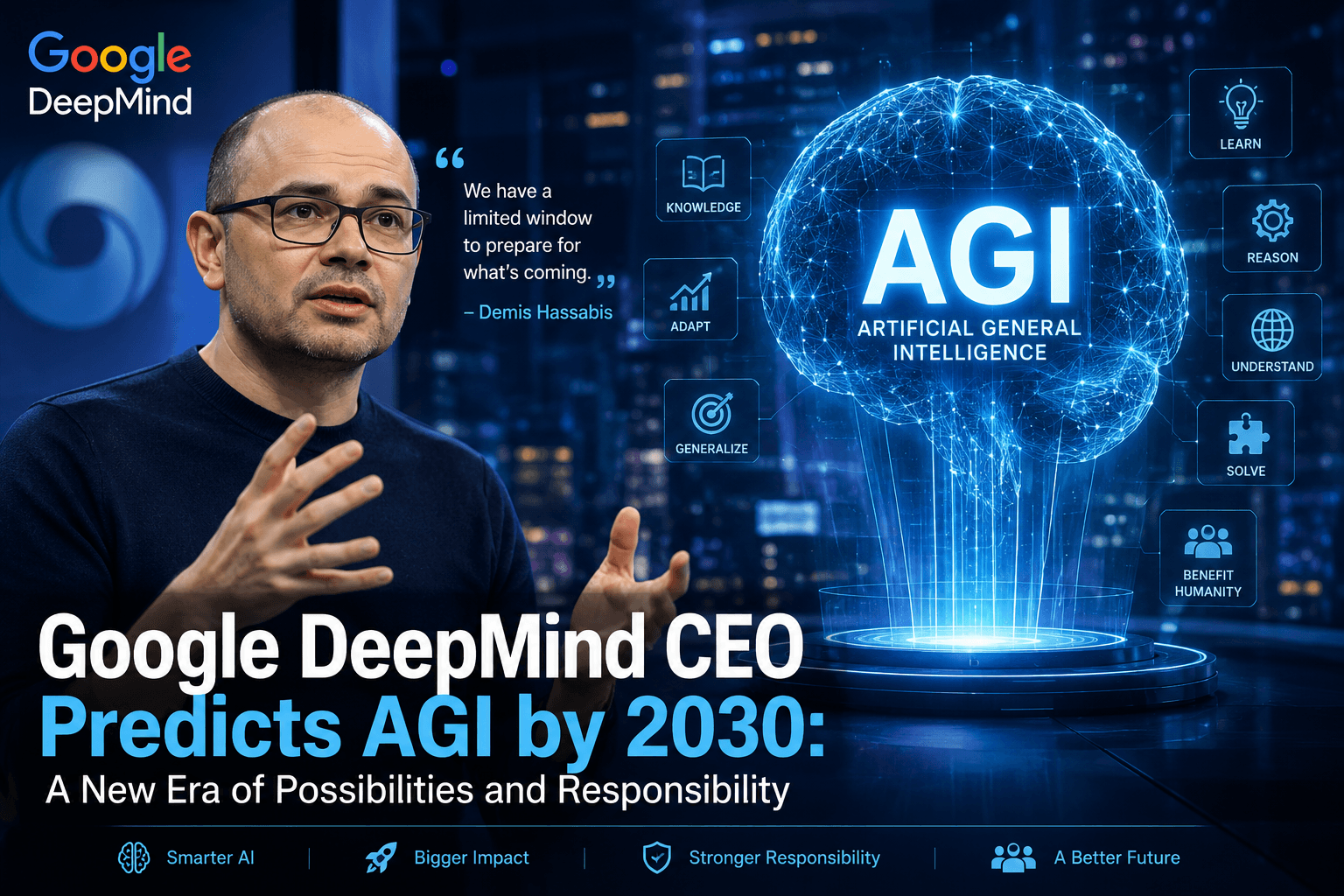
Artificial Intelligence is advancing at an unprecedented pace, transforming industries, reshaping workplaces, and changing how people interact with technology. While AI-powered chatbots, image generators, and coding assistants have already become part of everyday life, the next milestone in AI development could be far more significant: Artificial General Intelligence (AGI).
Recently, Google DeepMind CEO Demis Hassabis said that AGI could emerge around 2030 and emphasized the importance of preparing society for its arrival. He also argued for stronger international cooperation and oversight to ensure advanced AI systems are developed responsibly. These comments have reignited discussions among governments, researchers, businesses, and technology leaders about the opportunities and risks associated with highly capable AI systems.
In this article, we'll explore what AGI is, why this prediction matters, how it could reshape industries, and what organizations should start doing today.
What Is AGI?
Artificial General Intelligence refers to AI systems that can perform a wide variety of intellectual tasks at a human-like level, rather than excelling at only one specific task.
Today's AI tools are examples of narrow AI. They can:
Answer questions
Generate text
Analyze data
Write code
Create images
Translate languages
However, these systems are still specialized. AGI would go much further by learning new tasks, reasoning across domains, solving unfamiliar problems, and adapting with minimal human guidance.
While experts disagree on exactly when AGI will arrive, Hassabis suggested that the coming decade could see major breakthroughs if current progress continues.
Why This Announcement Matters
The significance of this prediction goes beyond technology enthusiasts. Businesses, governments, educators, healthcare providers, and financial institutions all have a stake in how advanced AI evolves.
1. Business Transformation
Organizations are already using AI to automate repetitive work, improve customer service, optimize supply chains, and support decision-making. If AGI becomes a reality, businesses may gain systems capable of handling far more complex workflows with minimal supervision.
This could dramatically improve productivity while also changing how companies structure teams and allocate resources.
2. The Future of Work
Rather than replacing every job, AGI is more likely to transform many roles. Routine administrative work may become increasingly automated, while demand for skills such as critical thinking, creativity, leadership, and AI governance is expected to grow.
Professionals who learn to collaborate effectively with AI tools may be better positioned in the evolving job market.
3. Scientific Discovery
One of the most promising applications of advanced AI is accelerating research. AI systems are already assisting with drug discovery, protein analysis, climate modeling, and materials science. More capable AI could help researchers solve complex problems faster than ever before.
Calls for Responsible AI Governance
Alongside optimism about AGI, Hassabis stressed the need for international cooperation and oversight. He argued that as AI systems become more powerful, governments and industry should work together to establish common safety standards and evaluation processes before deploying the most advanced models.
The debate reflects a broader challenge: encouraging innovation while reducing the risks of misuse, bias, cybersecurity threats, and unintended consequences.
Many policymakers are exploring approaches that balance economic opportunity with public safety.
Opportunities for Businesses
Companies that prepare early for advanced AI may benefit in several ways:
Faster data analysis and reporting
Improved customer experiences through personalized interactions
Smarter forecasting and demand planning
Enhanced fraud detection
More efficient software development
Better decision support using predictive analytics
For startups and small businesses, AI also lowers barriers by making sophisticated capabilities more accessible without requiring large teams or budgets.
Challenges That Cannot Be Ignored
Despite the excitement, significant challenges remain.
Workforce Reskilling
Employees will need continuous learning to work alongside increasingly capable AI systems. Organizations that invest in training may adapt more successfully than those that ignore these changes.
Privacy and Security
As AI processes larger amounts of sensitive information, protecting user privacy and securing data become even more critical.
Ethical Decision-Making
Questions about transparency, accountability, fairness, and bias will remain central as AI systems take on more important roles in society.
Regulation
Governments worldwide are still developing AI regulations. Businesses operating internationally may need to comply with multiple frameworks as new rules emerge.
What This Means for Data Analysts
For data analysts, AGI is unlikely to eliminate the need for human expertise. Instead, the role may evolve.
Future analysts may spend less time cleaning spreadsheets and more time:
Interpreting insights
Validating AI-generated recommendations
Communicating findings to stakeholders
Designing business strategies
Monitoring AI performance and governance
Those who combine technical skills with business understanding are likely to remain valuable.
Expert Perspective
Predictions about AGI timelines vary, and no one can say with certainty when—or if—human-level general intelligence will be achieved. What's clear is that AI capabilities are advancing rapidly, and organizations that prepare thoughtfully will be in a stronger position regardless of the exact timeline.
Rather than viewing AI only as a replacement for human work, businesses can treat it as a tool that augments human expertise, improves productivity, and enables new forms of innovation.
Conclusion
The discussion sparked by Google DeepMind's CEO is a reminder that AI development is moving quickly and raising important questions about the future of work, technology, and society. Whether AGI arrives by 2030 or later, organizations have an opportunity today to invest in AI literacy, strengthen governance, and identify areas where AI can create real value.
The companies that succeed in the coming decade are likely to be those that combine technological innovation with responsible leadership, continuous learning, and a commitment to using AI in ways that benefit customers, employees, and society.
Key Benefits of Artificial Workflow Automation
Increased Productivity
Boost operational efficiency.
Cost Savings
Boost operational efficiency.
Improved Accuracy
Boost operational efficiency.
Scalability
Boost operational efficiency.
Better Decisions
Boost operational efficiency.