
The Biggest Data Analytics Trends Every Business Should Watch in 2026
Data is no longer just something businesses collect—it's one of their biggest competitive advantages. In 2026, companies of all sizes are relying on data analytics to make faster decisions, understand customers better, and stay ahead of the competition. The biggest change isn't just the amount of data available; it's how quickly businesses can turn that data into meaningful action.
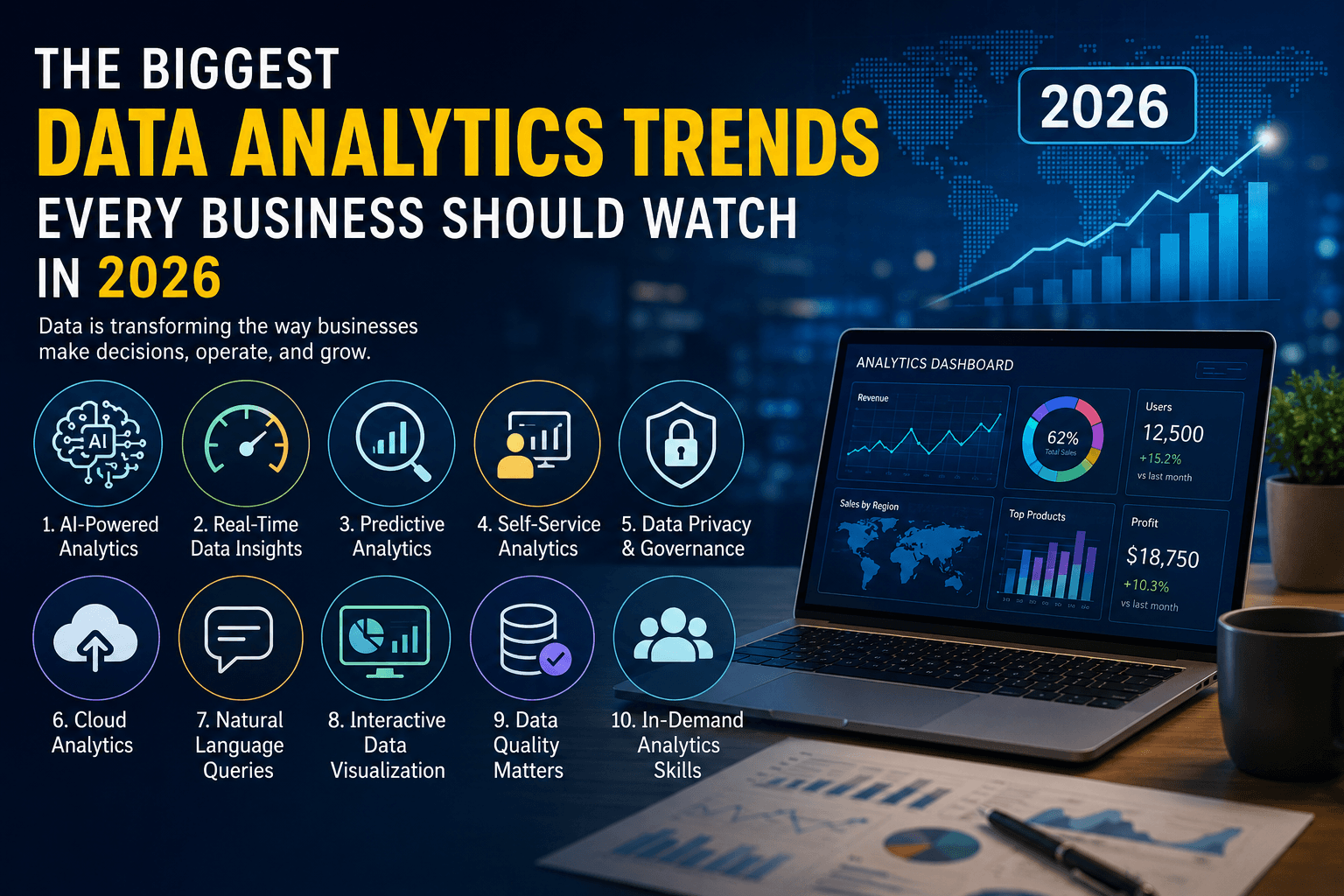
Whether you're a business owner, data analyst, or someone interested in technology, these are the trends shaping the future of data analytics in 2026.
1. AI-Powered Analytics Is Becoming the Standard
Artificial intelligence has become a natural part of modern analytics platforms. Instead of spending hours creating reports, businesses can now ask questions in plain language and receive instant insights.
AI helps organizations:
Detect hidden patterns in large datasets
Predict future sales and customer behavior
Identify unusual activities automatically
Generate reports within minutes
This allows teams to spend less time preparing data and more time making strategic decisions.
2. Real-Time Data Is More Valuable Than Ever
Waiting until the end of the day—or even the end of the week—for reports is becoming a thing of the past. Businesses now rely on real-time dashboards to monitor operations as they happen.
Examples include:
Retailers tracking live sales
Logistics companies monitoring deliveries
Banks detecting suspicious transactions instantly
Manufacturers identifying equipment issues before they cause downtime
Real-time analytics enables faster responses and reduces costly delays.
3. Predictive Analytics Is Driving Smarter Decisions
Businesses are moving beyond simply understanding what happened. They want to know what is likely to happen next.
Predictive analytics uses historical data along with machine learning to forecast future outcomes, such as:
Customer demand
Inventory requirements
Revenue growth
Employee turnover
Equipment maintenance
This helps companies plan with greater confidence instead of relying on guesswork.
4. Self-Service Analytics Is Empowering Every Department
Analytics is no longer limited to IT teams or data specialists. Modern tools allow employees across departments to explore data without writing complex code.
Marketing teams analyze campaign performance, HR departments monitor workforce trends, finance teams track budgets, and sales managers evaluate customer performance—all using user-friendly dashboards.
This shift helps organizations make data-driven decisions at every level.
5. Data Privacy and Governance Are Taking Center Stage
As businesses collect more customer information, protecting that data has become essential.
Organizations are investing in:
Stronger security policies
Role-based data access
Compliance with privacy regulations
Better data quality management
Transparent governance practices
Reliable data leads to better decisions and builds customer trust.
6. Cloud Analytics Continues to Grow
Cloud platforms have made advanced analytics accessible to businesses without requiring expensive infrastructure.
Benefits include:
Easy scalability
Lower maintenance costs
Faster collaboration
Secure data storage
Access from anywhere
Cloud-based analytics also supports remote and hybrid work environments, making collaboration easier than ever.
7. Natural Language Queries Are Simplifying Analytics
One of the biggest improvements in analytics software is the ability to ask questions using everyday language.
Instead of building complex queries, users can type questions like:
"Which products generated the highest revenue this month?"
"Show customer growth over the last six months."
"Which region had the highest profit margin?"
The software interprets the request and generates charts and insights automatically.
8. Data Visualization Is Becoming More Interactive
Modern dashboards are designed to help users understand information quickly.
Interactive visualizations now include:
Drill-down reports
Dynamic filters
Geographic maps
KPI scorecards
Automated alerts
AI-generated explanations
Good visualization turns complex numbers into clear business insights that everyone can understand.
9. Data Quality Is Receiving More Attention
Even the best analytics tools cannot produce reliable results from poor-quality data.
Businesses are focusing on:
Removing duplicate records
Standardizing information
Fixing missing values
Automating data validation
Improving data consistency
Clean data improves reporting accuracy and leads to more confident decision-making.
10. Analytics Skills Are Becoming Essential Across Industries
Data literacy is no longer limited to analysts. Employers increasingly expect professionals in marketing, finance, operations, healthcare, education, and retail to understand data and use it effectively.
Some of the most valuable skills in 2026 include:
SQL
Power BI
Microsoft Excel
Python
Data visualization
Basic machine learning concepts
Business intelligence
Professionals who can interpret data and communicate insights are in high demand across industries.
Final Thoughts
The future of business belongs to organizations that can make informed decisions quickly. In 2026, successful companies aren't necessarily collecting more data—they're using it more effectively.
From AI-powered insights and predictive analytics to real-time dashboards and self-service reporting, modern analytics is helping businesses become faster, smarter, and more customer-focused.
Whether you're leading a company, building dashboards, or beginning a career in data analytics, staying current with these trends will help you remain competitive in an increasingly data-driven world.
Key Benefits of Data Workflow Automation
Increased Productivity
Boost operational efficiency.
Cost Savings
Boost operational efficiency.
Improved Accuracy
Boost operational efficiency.
Scalability
Boost operational efficiency.
Better Decisions
Boost operational efficiency.