
Why Businesses Are Replacing Traditional Reports with AI Dashboards
For years, businesses relied on Excel files, PDFs, and weekly reports to understand their performance. While these reports still have their place, they often take time to prepare and quickly become outdated. In 2026, companies are choosing AI-powered dashboards because they provide live insights, automate repetitive tasks, and make it easier to understand data. Instead of waiting for someone to create a report, decision-makers can access updated information whenever they need it.
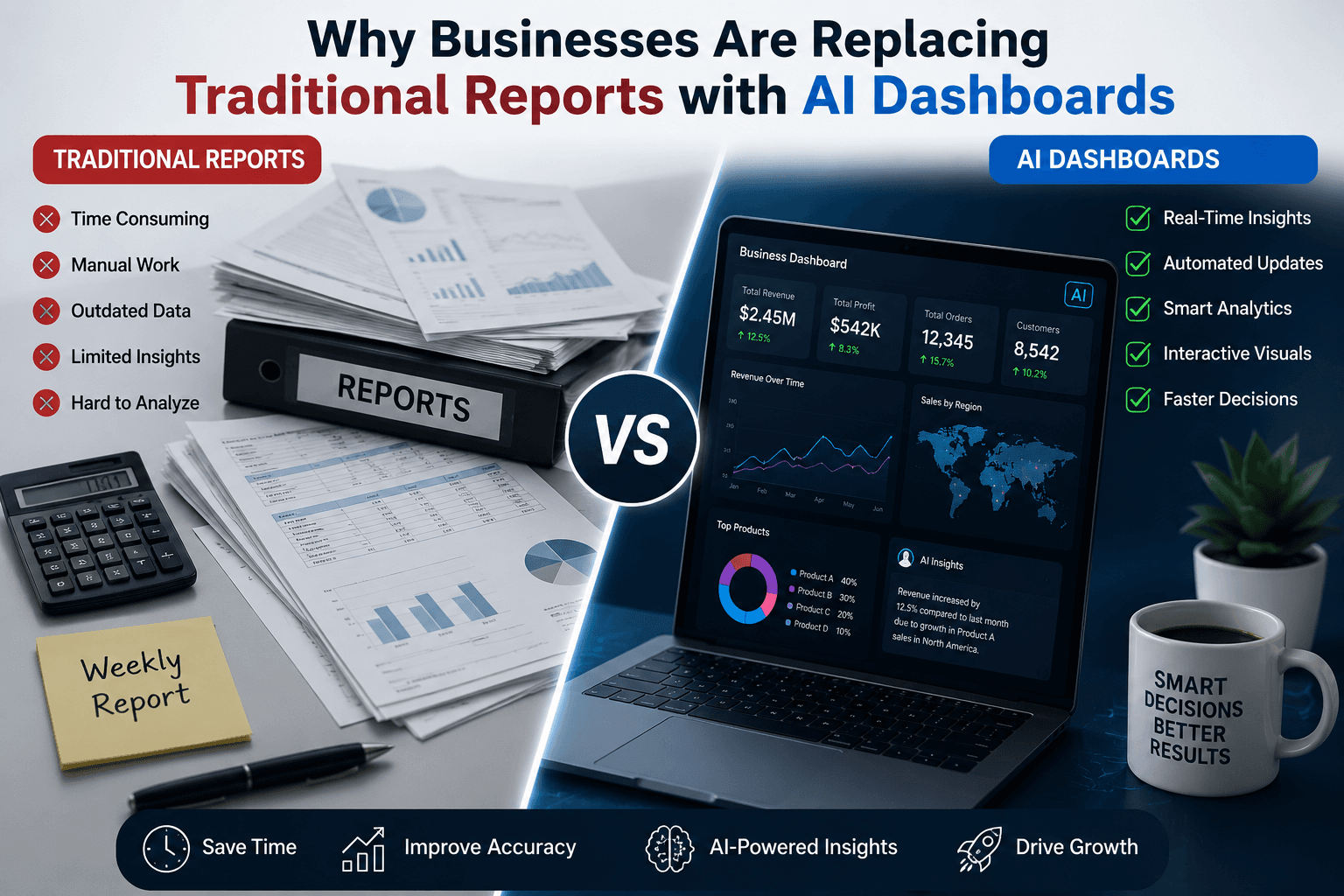
Traditional Reports Have Their Limits
Many businesses still spend hours collecting data from different systems before creating reports. By the time the report reaches managers, the information may already be outdated.
Some common challenges include:
Time-consuming manual work
Data that is already old by the time it's shared
Limited interactivity
Difficulty identifying trends quickly
Higher chances of human error
These issues slow down decision-making, especially in industries where data changes every hour.
AI Dashboards Make Data More Useful
AI dashboards are designed to work with live data. They automatically update as new information comes in and can highlight important changes without requiring manual analysis.
Instead of searching through multiple spreadsheets, users can see everything in one place.
Some key benefits include:
Real-time business insights
Automatic data updates
AI-generated summaries
Predictive analytics and forecasting
Easy-to-understand visualizations
Faster business decisions
This allows teams to spend less time preparing reports and more time acting on the information.
Better Decisions, Faster Results
Imagine a sales manager checking today's revenue instead of waiting until next week for a report. If sales begin to decline, the dashboard can immediately highlight the issue.
Marketing teams can monitor campaign performance in real time. Finance teams can keep track of expenses and cash flow without manually updating spreadsheets. Customer support teams can quickly identify trends in complaints and improve service before problems grow.
Having instant access to accurate information helps businesses respond faster and make more confident decisions.
AI Is Reducing Manual Work
Modern business intelligence tools now include AI features that automatically detect patterns, explain unusual changes, and answer questions in simple language.
For example, instead of manually filtering data, a manager can ask:
"Which products generated the highest sales this month?"
"Why did revenue decrease last week?"
"Which region is growing the fastest?"
The dashboard provides answers within seconds, saving valuable time.
Popular AI Dashboard Tools in 2026
Many organizations are adopting platforms that combine data visualization with artificial intelligence.
Some of the most widely used tools include:
Microsoft Power BI
Tableau
Google Looker Studio
Microsoft Fabric
Qlik Sense
These platforms help businesses transform large amounts of data into clear, actionable insights.
The Future of Business Reporting
Traditional reports won't disappear completely, but they are no longer enough for businesses that need quick, data-driven decisions.
AI dashboards offer a smarter way to monitor performance, identify opportunities, and solve problems before they become bigger issues. As AI technology continues to improve, dashboards will become even more intelligent, making business reporting faster, simpler, and more accurate
Key Benefits of Digital Workflow Automation
Increased Productivity
Boost operational efficiency.
Cost Savings
Boost operational efficiency.
Improved Accuracy
Boost operational efficiency.
Scalability
Boost operational efficiency.
Better Decisions
Boost operational efficiency.